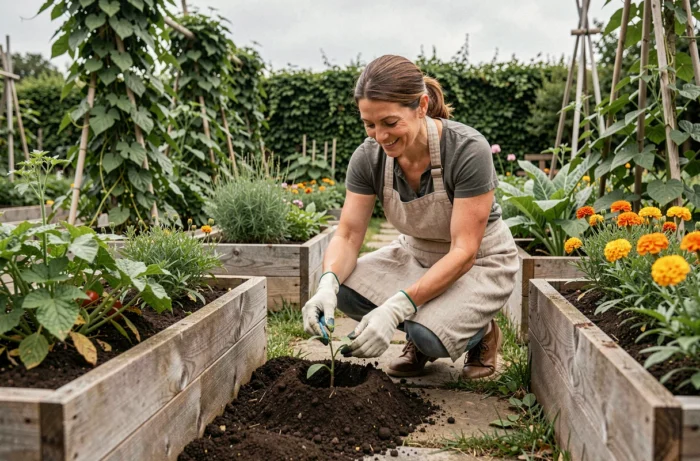
A natural vegetable garden does not start with sowing. It starts with the soil. Before choosing your varieties or laying out your rows, the earth beneath your feet determines the quality and quantity of what you will harvest. Creating a natural vegetable garden is first about understanding what happens in the first centimeters of soil, then organizing your crops so that each plant finds its place without chemical intervention.
Permanent beds and living soil: the foundation of a productive natural vegetable garden
Have you ever noticed that the paths between your rows of vegetables end up compacted, hard, and impermeable? This compaction does not just stay on the surface. It compresses the soil deeply and hinders the circulation of water and air to the roots.
The most effective solution is to adopt permanent growing beds that are never walked on. Specifically, you define strips of land about one meter wide, accessible from both sides, and you only walk in the aisles. The soil in the beds remains loose, aerated, and alive.
This organization offers a direct advantage: you can plant more densely. When the soil is not compacted, the roots explore a larger volume, and the vegetables develop better even when close together. You gain in planting density without sacrificing the vigor of the plants.
To nourish this soil, homemade compost remains the most complete addition. Peels, dead leaves, dry clippings: everything transforms in a few months into a rich amendment that you spread on the surface of your beds. There’s no need to bury it deeply. The soil fauna (earthworms, woodlice, fungi) incorporates the organic matter for you. Less soil work also means less disturbance to this underground life that naturally structures the earth.
When you want to start a vegetable garden with L’Herbe sous le Pied, this approach of living soil and fixed beds provides a solid starting point, even on a small area.
Permanent mulching in the vegetable garden: keeping the soil covered all year round
Exposed soil dries out, crusts under the rain, and becomes covered with unwanted plants in just a few weeks. Permanent mulching radically changes this dynamic.
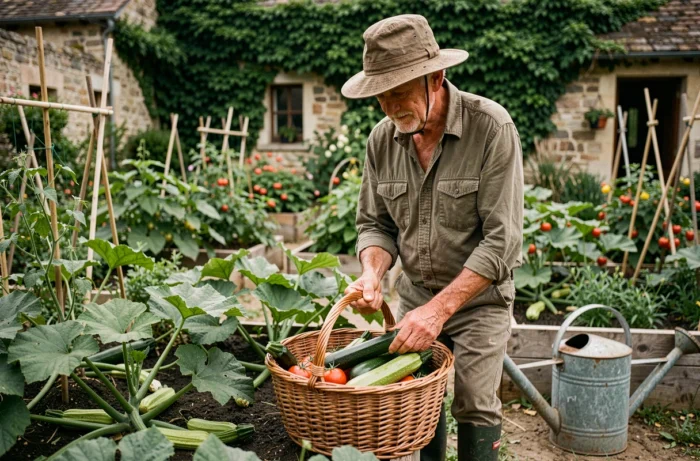
The principle is simple: cover the soil in all seasons with a layer of organic matter. Straw, hay, dead leaves, wood chips for the paths. This cover serves several functions at once:
- It retains soil moisture by limiting evaporation, which significantly reduces watering needs during the summer.
- It prevents the germination of most weeds by depriving them of light, saving you hours of weeding.
- It decomposes slowly and continuously nourishes the soil, acting like a natural fertilizer with gradual release.
Thickness matters. A layer that is too thin allows light to penetrate, and weeds will regrow. Aim for a sufficient thickness so that the soil underneath remains dark and cool to the touch, even in the height of summer.
A common trap: mulching on already dry soil. Always water before laying your mulch, otherwise, you trap dryness under the cover, and your plants struggle to hydrate.
Crop rotation and vegetable families: organizing crops to avoid soil depletion
Planting tomatoes in the same spot every year seems convenient. The consequences often appear as early as the second or third season: recurring diseases, declining yields, soil depleted of certain nutrients.
Crop rotation involves changing the location of each vegetable family from one year to the next. The principle is based on an observation: plants of the same family draw the same nutrients and attract the same pests. By moving them, you break the cycle of diseases and give the soil time to regenerate.
To simplify, group your vegetables into four categories:
- Fruit vegetables (tomatoes, zucchini, peppers): nutrient-hungry, they ideally follow a plot enriched with compost.
- Leafy vegetables (lettuces, spinach, cabbages): they appreciate still-rich soil but are less demanding than fruit.
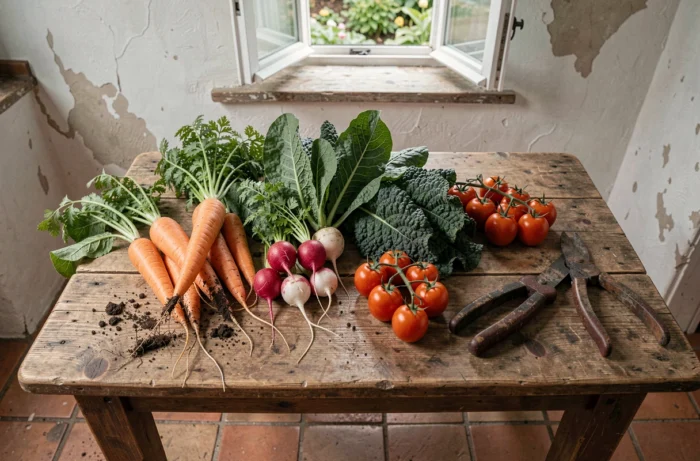
- Root vegetables (carrots, radishes, beets): they prefer loosened soil, without fresh compost that causes roots to fork.
- Legumes (beans, peas, broad beans): they fix atmospheric nitrogen in the soil and regenerate the plot for the next cycle.
With four permanent beds, you rotate these groups each year. Legumes prepare the soil for the nutrient-hungry crops that follow. This system also works on a small area, provided you respect the order of rotation.
Plant associations and observing the land: two often underestimated levers
Before even thinking about varieties, take the time to observe your land for a few days. Where does the shadow fall at noon? Where does the prevailing wind come from? Where does water stagnate after rain? This information is worth more than any vegetable garden plan copied from the internet.
A performing natural vegetable garden adapts to its environment. Place the vegetables that are sensitive to wind (climbing beans, tall tomatoes) sheltered by a hedge or wall. Install the crops that tolerate partial shade (lettuces, spinach) where direct sunlight does not exceed a few hours.
Plant associations enhance the resilience of the whole. The most well-known example remains the trio of corn, climbing beans, and squash: corn serves as a support for the beans, the beans fix nitrogen for all three, and the squash covers the soil with its large leaves. This is not a universal recipe, but the principle of mutual support among complementary plants applies to many combinations.
Adapting varieties to the local climate
Catalogs are full of attractive varieties, but not all are suitable for your region. Favor rustic varieties adapted to your climate and the length of your growing season. A less spectacular local variety will often produce more than a poorly acclimatized exotic hybrid.
A natural vegetable garden relies on coherent choices rather than miraculous techniques. Living soil, continuous mulching, methodical rotation, and attentive observation of the land form a system where each element supports the others. The first abundant harvests rarely come in the first year, but the fertility of the soil improves with each season if these principles are maintained.