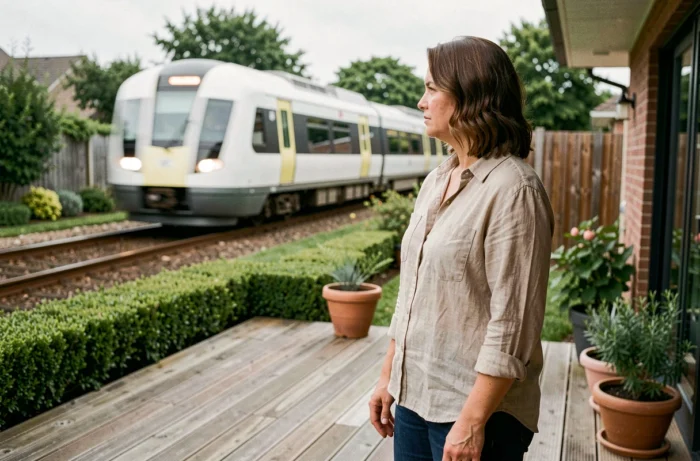
This high-speed rail ridership figure is far from insignificant: it reflects a reality shared by thousands of households across France. Living near a railway line means adapting to a distinctive sound environment, but it also comes with tangible advantages when it’s time to buy.
Railway noise classification: the first thing to check before buying
Distance from the tracks alone is not enough to assess potential noise disturbance. The infrastructure’s noise classification is the key factor. In France, every railway line is classified, with designated areas where new buildings must meet stricter sound insulation requirements.
For buyers, checking this classification in the local planning document provides far more reliable information than trying to estimate the noise from the garden. A house 150 metres from a Category 1 line will not offer the same level of comfort as one 80 metres from a lightly used secondary line.
French regulations have recently changed the way railway noise is measured. This change establishes a more precise measurement framework, although it does not, by itself, set new limits or create an automatic right to compensation. Buyers now have more refined regulatory tools to objectively compare two properties near railway tracks.
Buyers considering the benefits of a home near railway tracks should compare three factors: the line’s noise classification, the types of trains using it (freight, TER, TGV) and their schedules, particularly at night.

Assessing actual noise disturbance: line type, schedules and exposed rooms
The average noise level shown on a map does not tell the whole story. An average reading can conceal disruptive peaks caused by repeated train passages, especially at night. Disputes between residents living near high-speed lines and infrastructure operators show why it is important to assess train movements both day and night, rather than relying solely on an average noise level.
The most practical approach is to visit the property at different times. Count the trains passing during a one-hour period in the morning, around midday and in the evening. The type of train also matters: a TGV produces a brief, high-pitched noise, while a freight train creates longer-lasting low-frequency vibrations.
What to check in each room
- Bedroom orientation in relation to the tracks: a bedroom facing the garden on the opposite side of the house can significantly reduce perceived noise, even without special insulation
- Existing glazing: asymmetrical double glazing (with two panes of different thicknesses) reduces railway noise far more effectively than standard double glazing
- Air inlets: roller shutter boxes and ventilation grilles are often the weakest acoustic points in a façade, more so than the walls themselves
- Soil and foundations: on some clay soils, vibrations travel more easily, which can eventually cause hairline cracks in the façade
Noise-reduction measures on the infrastructure side target specific disturbances rather than promising complete silence.
Property prices near railway tracks: a discount that benefits informed buyers
Properties located close to a railway line almost always sell at a discount. For buyers who have checked the noise classification, assessed the actual disturbance and confirmed that the insulation is adequate, this discount becomes a tangible buying advantage.
You can pay less for a property whose indoor acoustic comfort is perfectly acceptable once the doors and windows are closed. The price difference can fund improvements—such as replacing the glazing or insulating roller shutter boxes—that may increase the property’s resale value.
Proximity to a station and neighbourhood value
A house near the tracks is often also close to a station. Access to rail transport remains one of the most sought-after features among buyers, particularly commuters who travel by train. Neighbourhoods with good rail connections also attract shops and services, supporting property values over the long term.
A discounted property in a neighbourhood served by rail can appreciate faster than a comparable property far from public transport. It is worth setting out the numbers clearly before ruling out a house simply because you can hear the train from the garden.

Everyday quality of life: what the train really changes
Reducing a household’s reliance on cars can make a significant difference to its monthly budget. Fuel, insurance, maintenance and parking: the true cost of a second vehicle is far higher than a train pass.
Beyond the savings, travelling by train frees up time. You can read, work or relax. A 40-minute train journey does not have the same effect on fatigue as a 40-minute drive in traffic.
Living near a railway can also encourage a lifestyle that combines train and bicycle travel, particularly well suited to suburban areas. As well as being more affordable, this type of mobility reflects a broader trend in French urban areas, where multimodal transport hubs are being developed.
People’s ability to adapt to railway noise is well documented. Unlike continuous road noise, a passing train is a brief and predictable sound event. The brain adapts to it more easily than to constant background noise. After a few weeks of living in a property, the perceived disturbance often differs from the first impression during a viewing. Checking that the home’s insulation meets the noise classification for the line remains the most reliable way to anticipate your actual level of comfort.