
A steam oven promises crunchy vegetables, tender meats, and golden-brown breads with a fine crust. But when it comes time to start cooking, one question arises: should you add water, and if so, where and when? The answer depends on the type of appliance you have, as not all steam ovens manage water in the same way.
Removable tray, integrated reservoir, or direct connection: identify your system
Before discussing quantity or frequency, it’s essential to understand how your oven produces steam. Three systems coexist on the market, and each requires a different action.
- The removable water tray is taken out of the oven, filled at the tap, and then replaced before cooking. This is the most common system in consumer models.
- The integrated reservoir works on the same principle but remains attached to the appliance. You pour water directly into a compartment accessible from the front or side.
- The direct water connection eliminates any handling. The oven fills automatically and then drains the excess after cooking. This system is mainly found in high-end or professional models.
If you have a removable tray or an integrated reservoir, the answer is clear: yes, you must add water before each use. On a connected model, the oven takes care of it automatically.
To delve deeper into this point according to your model, the advice from Le Comptoir des Délices details the steps to follow based on each configuration.
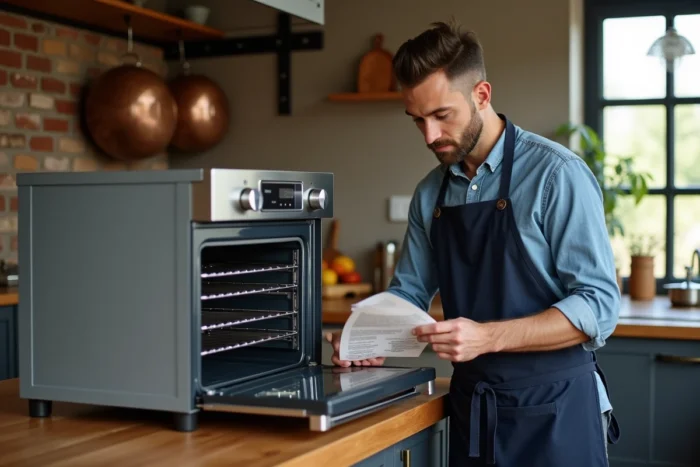
Tap water or demineralized water: what type of water to use
You may instinctively reach for demineralized water, as you would for an iron. In a steam oven, this choice can pose problems.
Some manufacturers explicitly advise against demineralized or filtered water. The reason is technical: water level sensors may misdetect filling with water that is too pure, as the electrical conductivity is too low. The oven may then display a level error even when the reservoir is full.
The most common recommendation remains plain tap water. If your local water is very hard or heavily chlorinated, still mineral water is a good alternative. It provides sufficient conductivity for the sensors while limiting limescale deposits.
Limescale and descaling: the real long-term issue
Tap water leaves limescale in the steam circuit. This is not a flaw; it is a parameter to manage. Most steam ovens include an automatic or semi-automatic descaling program.
Following the descaling frequency recommended by the manufacturer protects the steam generator and maintains cooking quality. Ignoring this step is like leaving a kettle scaled: steam production slows, temperature becomes irregular, and cooking suffers.
Filling the reservoir: before, during, or after cooking
The right moment to add water is not trivial. Here is the sequence that most manufacturers recommend.
Fill the reservoir before starting the program. The oven needs water from the preheating stage to generate steam at the right time. If you forget this step, the appliance usually emits a sound signal to alert you that the level is insufficient.
During cooking, some long programs may require additional water. The oven will alert you again with a signal. There’s no need to constantly monitor the reservoir.
After cooking, always empty the residual water. Stagnant water in a warm reservoir promotes bacterial growth and accelerates limescale buildup. Several recent models offer a dedicated drainage function that simplifies this action.
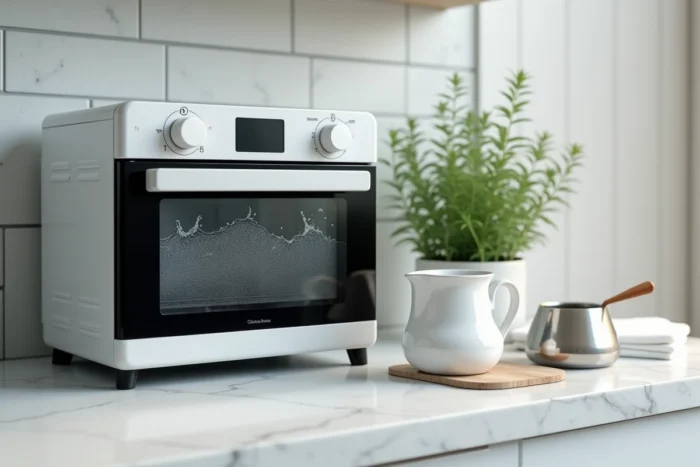
Too much water, not enough water: common mistakes and their consequences
Did you fill the tray to the brim just to be safe? On some models, excess water can flow directly into the oven cavity. Manufacturers indicate that this does not cause material damage, but water that stagnates at the bottom of the chamber disrupts cooking. Foods will stew instead of steaming, and the results will suffer.
Conversely, an insufficiently filled reservoir interrupts steam production mid-program. For a roast or bread, this interruption can compromise the final result. The crust of the bread may not form correctly, and the meat loses its tenderness.
The guideline is simple: fill to the maximum level indicated, without exceeding it. This marking exists on all removable trays and in most integrated reservoirs.
Combined steam oven: when water changes the game in convection mode
Combined steam ovens allow you to combine dry heat (convection) and steam injection. This hybrid mode uses humidity in a targeted manner, not continuously.
In combined mode, the oven injects steam at specific moments during the cooking cycle. For example, a roasted chicken in combined mode receives steam at the beginning of cooking to keep the meat juicy, then dry heat takes over to brown the skin.
In this case, the reservoir must be filled even for a predominantly dry heat program. If the oven detects an empty reservoir, it switches to a degraded mode without steam, and you lose the benefits of the combined program.
Pure steam cooking or combined: adjust the water level
In pure steam cooking (vegetables, fish), water consumption is higher than in combined mode. For a long cooking time of vegetables, ensure the reservoir is full. For a gratin in combined mode, half a reservoir is often sufficient.
You will quickly get the hang of it. After a few uses, you will be able to estimate the necessary amount based on the chosen program and cooking duration. The low-level sound signal remains your safety net.
The steam oven requires a simple but regular action: fill before, empty after, and use the appropriate water for your model. These three reflexes, more than the technology itself, ensure consistent cooking and a lasting appliance.